What is the best telescope?

What is the best telescope?
What is the best telescope?
What is the best telescope?

Aperture
Light entering the eyepiece is vitally important in a telescope, the ability to bring in light is limited by the aperture (diameter) of a telescope's mirror or its lenses.
If a telescope has a 70mm objective lens it receives 100 times as much light as the human eye does. An 8 inch telescope enhances the eye's ability to gather light by almost 1000 times!
So in every day terms, a larger telescope equals images that are brighter, sharper, clearer and bigger than a smaller one. This will make your viewing experience much better!
Around 400 years ago Galileo first invented The refractor telescope with a lens in front and an eyepiece at the back.
Smaller refractors with objective lenses from around 60mm to 90mm are very popular with telescope users starting out in home astronomy because they give clear, high contrast, quality views of bright objects.
A 70mm refractor on an Alt-Azimuth mount would be a great first telescope for a someone starting out because it is inexpensive, easy to use, and offers great detail on the Moon and planets.
Bigger refractors can suffer from "chromatic aberration" which also known as false color or blue fringing unless the objective lens is made of expensive ED or Fluorite glass.
Reflector Telescopes
The first reflector telescope was invented by Sir Isaac Newton in 1668.
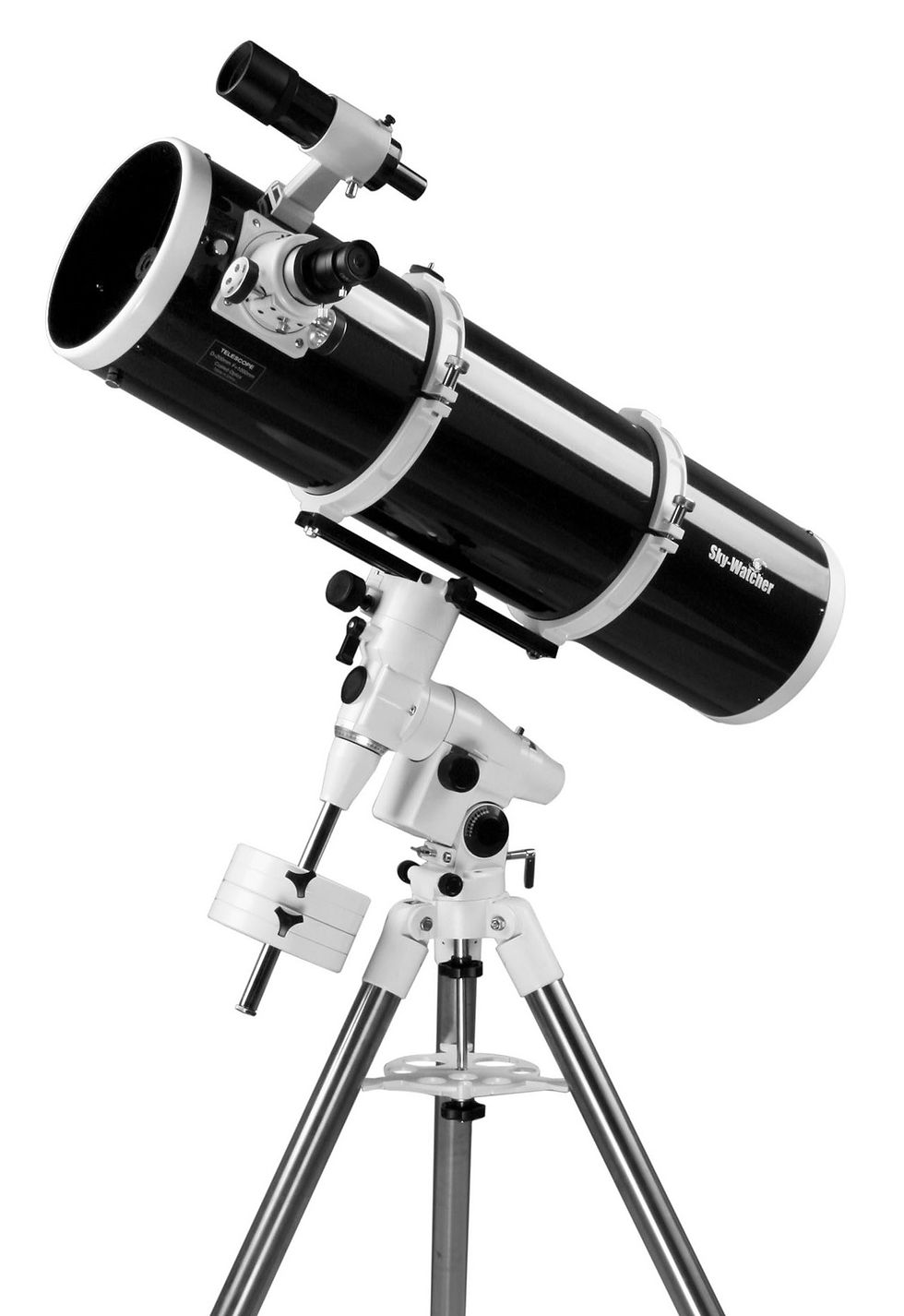
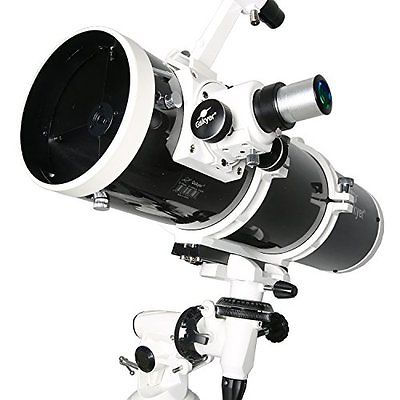
Reflector Telescopes use mirrors instead of lenses. Reflector telescopes will give you more light gathering power for your money than any other telescope design.
However Reflector Telescopes do need a little bit more patience to use because the mirrors inside will need to cool to the temperature of the night air before they produce their clearest, crispest images. The mirror might also need to be aligned or "collimated" now and then.
Dobsonian reflectors that are up to eight or even ten inches in aperture can be handled easily by a single user and are large enough to show hundreds of galaxies and resolve globular clusters into thousands of individual stars giving you some spectacular results.
Catadioptric Telescopes
Compound, also known as catadioptric telescopes are a more modern invention.
Using a combination of both mirrors and lenses these compound telescopes are "folded" along an optical path into a neat, compact telescope body.
Catadioptric telescopes are very well suited for use with automated computerized mounts. These automated, computerized mounts will help you find thousands of stars, galaxies, and galactic nebula.
However they will need a source of power such as a rechargeable battery because smaller AA type batteries will only last a few hours.
Automated, computerized telescopes featuring a 90mm to 8 inch Catadioptric design are very popular because they offer a terrific combination of power and portability and stunning results.
Eyepieces
Most modern telescopes will be packaged with one or two eyepieces in the 1.25 inch size.
Changing the eyepiece will change the magnification of the telescope because the magnification power is equal to the focal length of the telescope divided by the focal length of the eyepiece.
For example, a telescope with a focal length of 900mm and a 10mm eyepiece will magnify the image by 90 times. 900mm/10mm = 90x magnification!
There are lots of eyepiece designs, but "plossl" eyepieces have become the most popular type in recent years because they will give you great performance for a good price.
Some specialty wide field eyepieces can sell for hundreds of dollars, but have many fans because of their performance.
Try to avoid older telescopes that use the older style 0.96" size eyepieces because they often use H type or Huygenian eyepieces which are very well known for fuzzy, disappointing images and a very narrow field of view.
Magnification
One of the key specifications that telescope makers often will list is "maximum useful magnification" this is usually about 50 times the telescope aperture in inches or double the aperture in millimeters.
A 70mm refractor will show great detail of the moon up to 140x magnification. if you push the magnification beyond 140x you will see an image that is larger but also fuzzier and of a much lower quality.
Be careful of small telescopes that claim to have up to 500x magnification or even more, it will be almost impossible to see anything crisp and clear at that level of magnification and you will be disappointed.
Optical Coatings
Simply put, plain glass reflects light.
Telescope lenses and their eyepieces may lose a lot of light due to reflection on each of the optical surfaces.
Many designers of optics have overcome this problem by adding anti-reflection coatings to glass surfaces, similar to the coating you may find in your eye glasses.
Multi-layer coatings can often be much more efficient and effective than single layer coatings. The term "multi-coated" often means that one surface has been treated with multi-layer coatings while internal surfaces may just have single layer coatings. "Fully multi-coated" means that every air-to-glass surface has multi-layer anti-reflection coatings for optimal performance.
Finder Scopes
Telescopes will need a small finder scope with a wide field of view to find the subject that you want to observe with your telescope because the main scope will often show a field of view so narrow that objects can be almost impossible to find through the eyepiece.
Red-dot finders are probably best suited for finding brighter objects such as the moon and planets.
A 6x30 or a 9x50 optical finder scope is a small scope with a cross hair attached to the side of your telescope that you will use to aim your telescope precisely at the item you would like to observe.
Alt-Azimuth Mounts
A good steady, sturdy telescope mount base is essential for being able to get a great view of your subject.
The Alt-Azimuth mount is light and very easy to use because it allows you to move up and down (altitude) or side to side (azimuth).
The drawback is that an Alt-Azimuth mount is that it cannot track stars and planets unless it has a built in automated computer device.
Once you get the Moon or even a planet centered in the eyepiece, the Earth's rotation causes it to drift toward the edge, which will need periodic adjustment to keep your subject in view.
Because of this, these manual Alt-Azimuth mounts will work best for smaller telescopes with lower magnifications.
Equatorial Mount
The equatorial mount is often also known as a German Equatorial Mount (GEM) because it was invented in Germany.
An equatorial mount uses a clever combination of counterweights to balance the telescope, and also allows the telescope to track stars and planets with a single slow-motion control or with a motor to drive it.
A good quality equatorial mount can cost more that the optical parts of a telescope, however it will keep a planet centered in the eyepiece at high power or even allow photographs to be taken through your telescope.